India’s Economic Growth Surge
 FTII Association
0 comments
FTII Association
0 comments
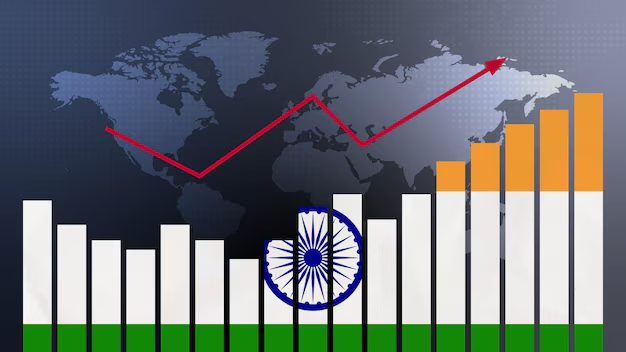
India, set to become world’s 3rd largest economy as the growth engine accelerates.
Prime Minister Narendra Modi voiced optimism asserting that India is poised to secure the position of the world’s third largest economy during the BJP government’s third consecutive term at the Centre.
“Modi ki guarantee yani guarantee pura hone ki guarantee”, the prime minister said, at the “Ahlan Modi” event recently.
 India is set to become the third largest economy in the world by 2029; Likely to surpass Germany (GDP of $4 Trillion) by 2027, and Japan (GDP of $ 4.2 Trillion) by 2029.
Indian economy was 2 trillion in current US dollars in 2014.It stood at 10th position in the global ranking of GDP published by the IMF. UK was at 5th position with 3 trillion current dollars. France, Brazil, Italy, and Russia were at 6th, 7th, 8th, and 9th positions respectively.
Chief Economic Adviser V Anantha Nageswaran said the Union government has built infrastructure at a historically unprecedented rate, and it has taken the overall public sector capital investment from ₹5.6 lakh crore in FY15 to ₹18.6 lakh crore in FY24, as per budget estimates. India’s strong FDI inflows have been boosted by large inflows of investments from global technology MNCs such as Google and Facebook that are attracted to India’s large, fast-growing domestic consumer market, as well as a strong upturn in foreign direct investment inflows from manufacturing firms and with a diverse and rapidly growing economy driven by key sectors such as IT, services, agriculture, and manufacturing. India capitalizes on its large domestic market, young and tech savvy workforce, and growing middle class.
India’s growth rate was the second highest among G20 countries and almost twice the average for emerging market economies. This resilience was underpinned by robust domestic demand, strong public infrastructure investment and a strengthening financial sector.
Amidst a challenging global scenario, India has emerged as a significant economic and geopolitical power. Its actions in the coming years could lay the groundwork for the country to become the world’s third largest economy with a GDP of 5 trillion. India’s efforts to maintain stability and enact structural reforms have contributed to its economic resilience in the face of global challenges.
Investments in upgrading infrastructure and connectivity, including projects like the Bharat Mala highway programme, the Sagar Mala project for portled development and the Smart Cities Mission, are transforming the country’s landscape and playing a pivotal role in the country’s economic advancement.
 India began laying a solid foundation for a more digital economy over a decade ago with the launch of its national identification programme, Aadhaar, which uses biometric IDs to establish proof of residence. Today, with a burgeoning tech industry, the country has become a key Centre for innovation and technology services, not only boosting economic growth but also positioning India as a key player in shaping the future of the digital economy.
In the face of escalating climate-related concerns, India also plays a key leadership role in the global fight against climate change. Through the launch of the Mission LIFE of Lifestyle for Environment, coupled with a concerted push for Green Hydrogen, India has demonstrated a firm commitment to a growth trajectory that balances economic advancement with ecological responsibility.
India has also launched the International Solar Alliance and the Coalition for Disaster Resilient Infrastructure and proposed a global grid for renewables. A major announcement made by Prime Minister Modi at COP28 in Dubai was the introduction of the Green Credit Initiative as a substitute for carbon credits.
India’s growth story continues. Because of the well thought through policies of Modi government, Indian economy is comfortably poised to cross 5 trillion dollars in 2026. Indian youth aspire to fulfill their dreams in a country filled with opportunities. They want an enabling environment.
They are ready to push the boundaries of innovation. India will become a developed nation by carrying out the appropriate action plans under the leadership of our visionary prime minister. India is poised to play defining role in shaping the future of the global economy in 2024 and beyond.
The Editor’s note by Dr. Sanjay Bansal (National President of FTII)